League Table or Knockout Bracket: Two Ways to Set a Contest
League table or knockout bracket: learn what each format says about a team’s standing, what a defeat changes, and how to read the next match.
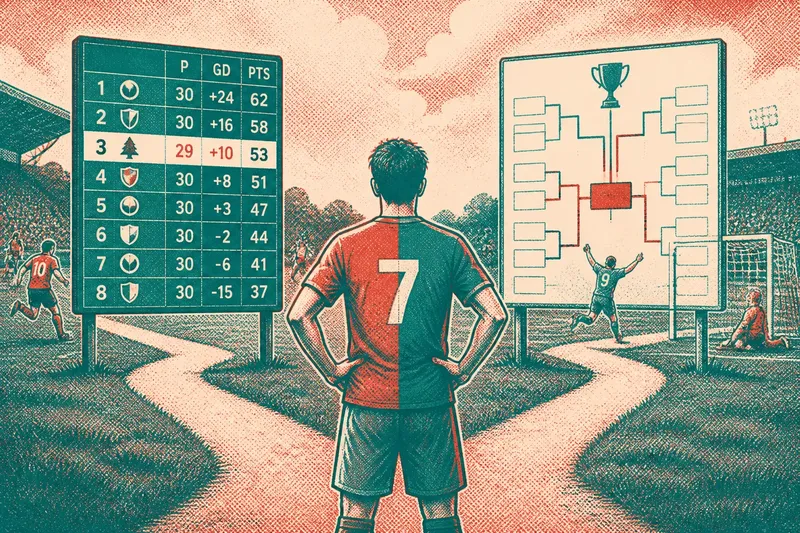
A team loses on Saturday, then meets the same opponent again the next week. In a league table or knockout bracket, that defeat has a different consequence: one result adds to a season-long record, while another can end a team’s route through the competition.
What does a league table measure?
A league gathers results across a schedule. Teams earn points or another stated reward for each outcome, and the accumulated record determines their positions. A loss changes the table, but ordinarily does not remove a team from the competition.
The format rewards a body of results rather than success in one pairing. A strong run can make up ground after a poor afternoon, although the available chance to respond depends on the fixtures still to come.
Positions can be misleading when teams have played different numbers of matches. The table may also use tie rules beyond points, such as goal difference, points difference, or head-to-head results. Its notes explain which measures settle a level record.
Say Cedar FC has played one fewer match than Harbor FC and sits just below it. In this invented situation, Cedar wins its postponed fixture; the visible result is a changed table position or a smaller gap, while both teams remain in the league. The final order still depends on later results and the competition’s tiebreak rules.
What does a knockout bracket decide?
A bracket shows a route through successive pairings. In a straightforward knockout round, the winner advances and the loser is eliminated. The chart identifies progression, not a complete ranking of every team that entered.
That makes each pairing unusually consequential. A team can leave after one unfavorable result, while an advancing team has established only that it won the required match or tie—not that it would outperform every other entrant across repeated meetings.
Some knockout contests use two legs, with the combined score determining who advances. Others use a single match, sometimes at a neutral venue. If the relevant score is level, the rules may call for extra time, a shootout, a replay, or another decider; the bracket graphic alone may not specify which.
Broadcasts can display both the live score and the aggregate score in a two-leg tie. Check the on-screen labels and competition rules to see which figure determines advancement. That distinction can change whether a team needs a goal, can protect its lead, or must wait for a decider.
What should you check when the format is unclear?
Start with the competition name and its rules page, then use the fixture list or table notes to resolve the specific question. These checks distinguish an ongoing schedule from an elimination route without relying on the shape of a graphic.
- Observation: the page lists teams in a table with points or another accumulated score. If it does, treat the result as part of a continuing record; if it does not, check the round label before assuming a loss means elimination.
- Observation: teams have played unequal numbers of matches. If they have, avoid treating their displayed positions as a like-for-like comparison; if they have not, consult the tiebreak rules when their totals are level.
- Observation: the fixture is labeled as the first or second leg. If it is, check the aggregate score and advancement rule; if it is a single-match tie, look for the stated method for resolving a draw.
- Observation: a bracket has an open place or a team skips a round. If the rules describe a bye or preliminary stage, follow that route; if they do not, check for a postponed fixture or an unreported result.
- Observation: the match ends level. If league rules award a draw, record it as that result; if the knockout rules require a winner, check whether extra time, a shootout, a replay, or another procedure follows.
- Observation: the standings page shows a tie but gives no obvious ordering reason. If its notes name a tiebreaker, compare that measure; if not, consult the competition’s official rules rather than guessing from the display.
How do schedule and stakes change what teams manage?
A league asks teams to handle a sequence of fixtures. Coaches may consider player availability, travel, recovery, and the demands of upcoming opponents. A dropped result matters, but the schedule may leave room to respond.
A knockout pairing puts the immediate route in the foreground. Across two legs, a team manages the combined score as well as the current match; in a single-match tie, there is no return fixture in that pairing. The exact choices still depend on the rules and circumstances.
For a viewer, the useful question differs by format. In a league, ask what the result changes in the table and how the remaining schedule affects that position. In a bracket, ask what is needed to advance and which tie-breaking procedures remain available.
Incomplete schedules and unusual outcomes also require competition-specific rules. A postponed league match can leave teams with unequal records for a time, while a bracket may need a procedure for a draw or withdrawal. The table or chart shows the structure; the rules explain how it handles exceptions.
Which questions help explain the result?
Why does a team still have matches after losing?
It may be playing in a league or group stage, where results accumulate, or in a multi-leg knockout tie with another match scheduled. Check the competition label and fixture list; the next match alone does not establish whether the team remains in contention.
Why are two teams level in different table positions?
The competition may apply a tiebreaker, or the teams may have played unequal numbers of matches. Read the table notes and compare the stated measure before treating the display order as a simple points ranking.
Why does a bracket show an empty or uneven path?
Some competitions give teams a bye or use preliminary rounds to fill later pairings. Check the round labels and advancement rules; an open place does not necessarily mean a result is missing.
Why can a tied match continue after the scheduled end?
A knockout round may require one team to advance, so its rules can provide extra time, a shootout, a replay, or another decider. A league may allow a draw if its scoring system recognizes that outcome.
Which format answers which question?
A league table answers who has assembled the strongest record across its scheduled meetings, subject to the scoring and tiebreak rules. A knockout bracket answers who has advanced through its pairings. The first organizes a continuing comparison; the second organizes progression.
That distinction is the most useful way to read a league table or knockout bracket. Check whether the competition is accumulating results or eliminating teams, then interpret the next fixture accordingly: as another entry in a record or as a chance to advance.
One final detail can prevent a mistaken reading: identify whether the displayed score is for the current match or the whole tie. Once that is clear, the format’s consequence is usually plain, even when the graphic has chosen to make it look like a small puzzle.